
Your rider confidence rescue call is booked! 🤩 🏇🏻 🎉
Before we speak, please watch this…
…then read this👇🏼
If your horse has become a source of anxiety instead of joy – this could be the most important page you’ll read this year
Before your Rider Confidence Rescue Call, there are two things I’d really like you to do:
- Watch the short video above.
- Then read this page all the way through.
It will help you understand why your rider confidence may have changed, why the things you’ve already tried may not have created lasting change, and what actually needs to happen for your confidence to become calmer, stronger and more reliable.
Most importantly, understanding this before we speak means we can spend much more of your call focusing on you, your horse and what you really want to change, rather than starting from the beginning.
Please read what follows before your Rider Confidence Rescue Call.
TRUSTED BY

TRUSTED BY

APPEARING ON

APPEARING IN

A reset is not a rewire
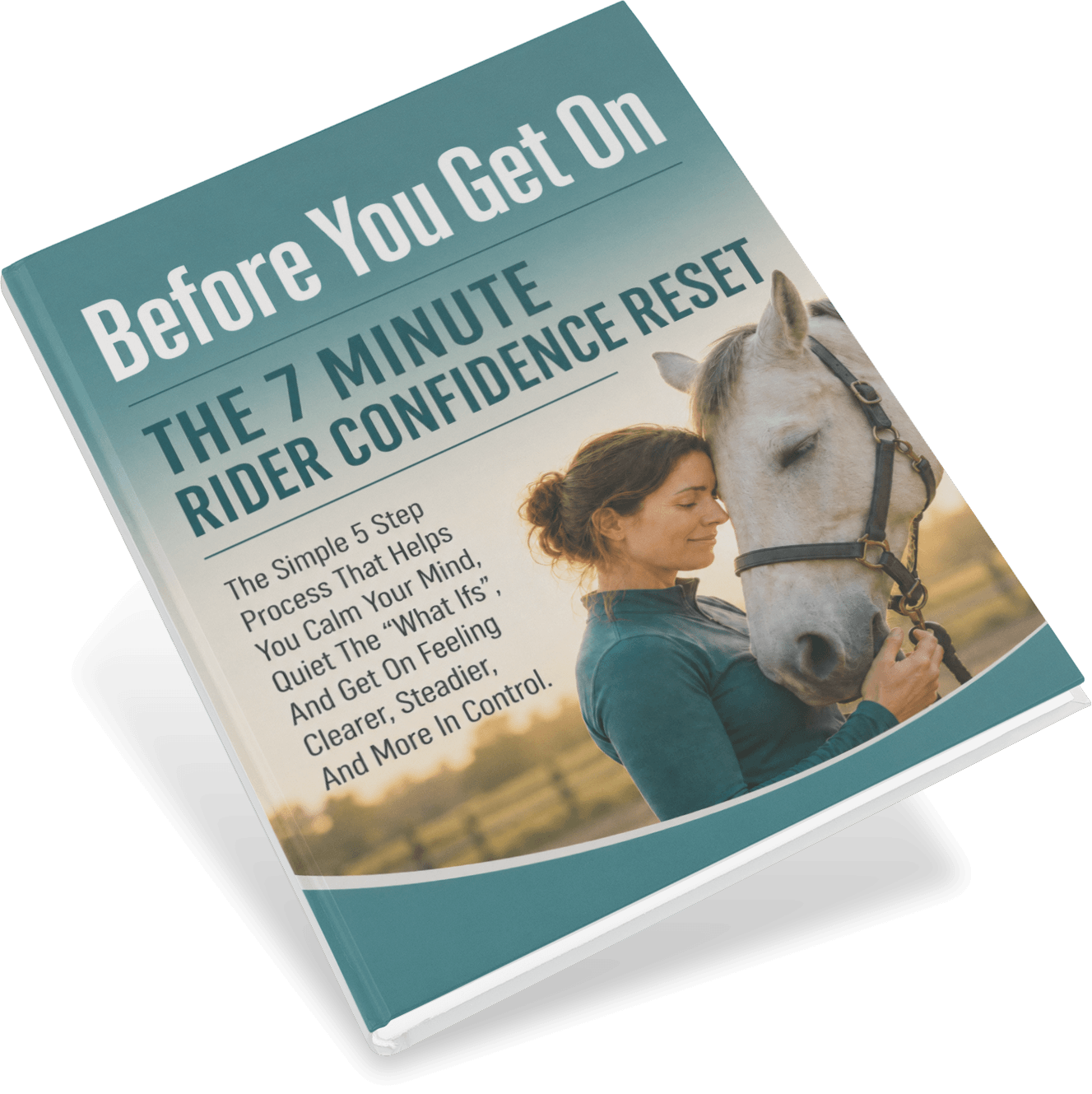
The 7 Minute Rider Confidence Reset gives you practical tools you can use when nerves or anxiety begin to show up.
It can help you calm your body, quieten the “what ifs”, bring your attention back to what is actually happening and get on feeling clearer, steadier and more in control.
And those tools can be incredibly useful.
But there is an important difference between resetting your response and changing the pattern that keeps creating the response in the first place.
A Reset…
helps you respond differently when anxiety appears
A Rewire…
changes the patterns that are causing your brain and body to create that anxiety
If you have been struggling with your riding confidence for weeks, months or even years, you have probably tried plenty already.
Breathe. Relax your shoulders. Look up. Ride forwards. Trust your horse. Think positively.
More lessons. A different instructor. More safety equipment. Avoiding certain situations. Perhaps even wondering whether you need a different horse.
Some of it may have helped.
But if the same nerves, dread or “what if” thoughts keep coming back, the problem may not be that you have not tried hard enough.
You may have been managing the symptoms of anxiety, rather than changing the process that keeps creating it.
And that is where deeper rider confidence work begins.
“If I know I can ride, why does my body still react like something is wrong?”
Why you can know you can ride and still feel afraid
One of the things I hear from riders all the time is:
“I don’t understand it. I know I can ride.”
And very often, they are absolutely right.
You may have ridden for years. You may know your horse well. You may have successfully hacked, jumped, cantered, competed or handled exactly the same situation countless times before.
Your riding ability may not have disappeared at all. And yet…
Your stomach still drops.
Your breathing changes.
Your hands tighten.
Your muscles brace.
Your mind starts racing ahead to everything that might go wrong.
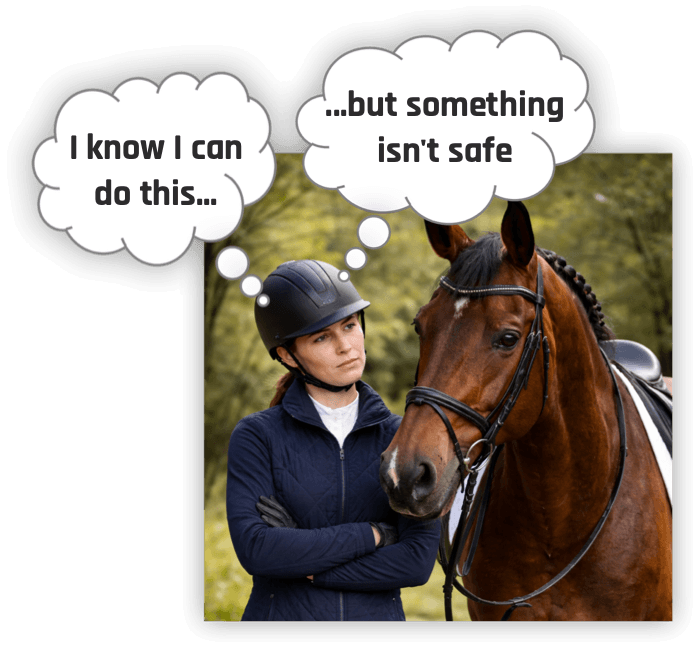
That can feel incredibly confusing because one part of you is saying: “I know I can do this.” While another part seems to be saying: “Something isn’t safe.”
Riding skill and psychological confidence are not the same
There are really two kinds of confidence involved in riding.

Practical confidence
comes from your riding ability, experience, training and the work you do with your horse and instructor.

Psychological confidence
comes from your brain and body feeling safe enough for you to access those skills calmly and clearly when you need them.
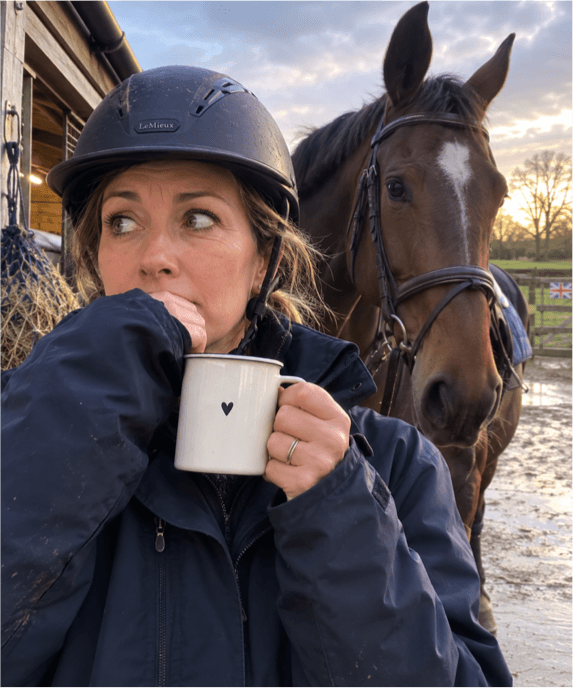
And this is where many capable riders get stuck.
You can have all the practical ability you need and still find that your nervous system reacts as though something dangerous is about to happen.
When that happens, your body begins preparing to protect you.
That does not necessarily mean you need to become a better rider.
It may mean your brain needs to become better at recognising when you are actually safe.
Think of it like a smoke alarm that has become too sensitive
A smoke alarm has an important job. If there is a fire, you absolutely want it to sound.
But imagine if the alarm went off every time you made a piece of toast.
The alarm itself would not be useless. Its purpose would still be important. It would simply have become too sensitive.
That is a useful way to think about what can happen with rider anxiety.

After a fall, scare, injury, difficult experience or even a gradual build up of stress, your brain can become more protective around situations it associates with danger.
So although your rational mind is saying:
“I’ve done this before. I know what I’m doing.”
your survival brain may already be saying:
“Be careful.”
And because that reaction happens automatically, you cannot always reason yourself out of it.
The goal of rider confidence work is not to convince you that nothing can ever go wrong.
It is to help your brain become better at distinguishing real danger from perceived danger, so you can respond to what is actually happening rather than what your alarm system fears might happen.
Very often, the problem is not that you have forgotten how to ride.
The problem is that your brain’s alarm system has become too sensitive.
“What happens if my brain keeps treating riding like something I need to protect myself from?”
When anxiety starts making your world smaller
Rider confidence rarely disappears in one neat, obvious way.
Sometimes there is a clear turning point: a fall, a scare, an injury or a moment when something suddenly felt out of control.
But often, the change is much quieter.
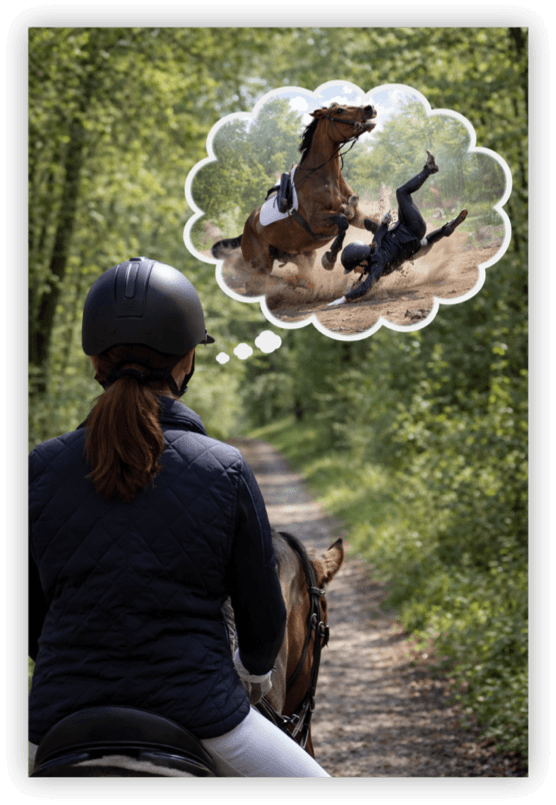
You start making small adjustments.
You decide not to hack alone today.
You put off the canter until next time.
You avoid the road, the open field, the busy warm up or the bigger jump.
You choose not to enter the competition.
You wait for somebody else to be at the yard before you ride.
You tell yourself you will do it when the weather is better, when your horse is calmer, when life settles down or when you feel more confident.
And every one of those decisions can feel perfectly sensible in the moment.
Because when you avoid the thing that is making you anxious, you feel relief…
And relief can quietly teach your brain the wrong lesson
Your brain notices that relief. It can begin to learn: “We avoided that, and now we feel safer.”
So next time, avoidance becomes even more tempting.

Little by little, the things you feel comfortable doing can reduce, while situations that once felt ordinary start to feel increasingly difficult.
Perhaps you still ride regularly. Nobody around you may even realise you are struggling.
But instead of simply riding, you find yourself managing your nerves around riding.
You are still riding. But you are no longer riding freely.
Sometimes the cost is not what you stop doing…
…it is what you stop enjoying
You may still go to the lesson but spend the previous evening worrying about it.
You may still compete but feel sick before you get there.
You may still hack but spend the whole ride scanning for the next thing your horse might react to.
You may still get on, but instead of feeling pleased afterwards, the strongest emotion is simply:
“Thank goodness that’s over.”
And that matters.
Because your horse was never meant to become something you endure. For most riders, they are one of the most important and rewarding parts of life.
Your horse experiences your internal state too
When you feel anxious, your breathing can change.
Your muscles tighten.
Your posture changes.
Your attention moves towards threat.
Your aids and decisions can change too.
That does not mean every problem with your horse is caused by you.
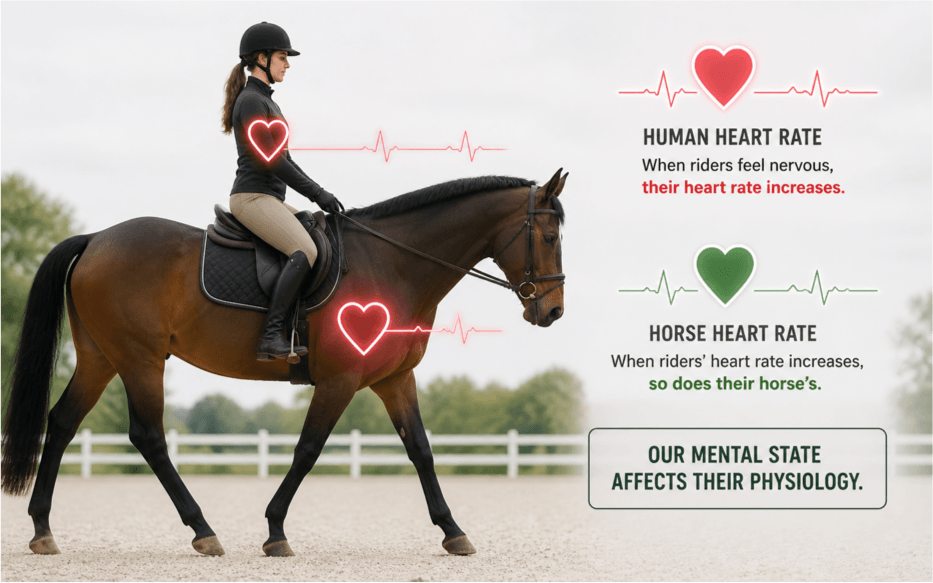
Pain, training, management, environment and your horse’s own experiences all matter.
But your mental and emotional state is part of the partnership.
The calmer and clearer you are, the better able you are to respond rather than react, make good decisions and remain present with your horse.
And that is why rider confidence work is about much more than simply feeling less nervous.
It is about getting back the freedom, enjoyment and connection that anxiety can gradually take away.
“If this is what’s happening, why haven’t all the things I’ve already tried fixed it?”
Why seemingly sensible solutions can still leave you stuck
If your confidence has been troubling you for a while, there is a good chance you have already tried to do something about it.
Probably several things…
You may have taken more lessons
Changed instructor
Bought an air jacket or other safety equipment
Chosen quieter places to ride
Avoided certain situations until you felt more ready
Tried breathing exercises, visualisation or positive thinking
Asked somebody else to ride your horse
Bought a steadier horse
Or simply told yourself: “I just need to ride more and get over it.”
And some of those things may genuinely have helped.
The problem is not that they are necessarily wrong.
The problem is that confidence does not come from one place
If your body is sounding the alarm, a positive thought may not be enough to calm it.
If your nervous system feels relatively settled but your mind is repeatedly imagining everything that could go wrong, calming your breathing alone may not stop the anxiety returning.
If you fundamentally doubt yourself, one mistake or difficult lesson can knock your confidence again.
And if your attention is constantly being pulled towards what your horse might do, what happened last time or what everybody else is thinking, it becomes much harder to stay present and ride what is actually happening.
That is why one technique can sometimes make you feel better for a while…
…only for the same problem to appear again somewhere else.
Even “just ride more” can produce the wrong result
Riding experience is important.
Lessons are important.
Good training is important.
But simply accumulating more time in the saddle does not guarantee that your brain is learning confidence.
If every ride becomes something you have to push yourself through, your brain can keep rehearsing the message:
“Riding is something we need to survive.”
Rather than learning:
“I can handle this calmly.”
That is why one technique can help for a while, yet the same anxiety returns somewhere else.
You don’t need another isolated tip. You need to work with the complete confidence system.
Your nervous system.
Your thoughts.
Your relationship with yourself.
Your focus and attention.
And that brings us to the four parts of genuine rider confidence
“So what actually has to change for confidence to become reliable?”
The four parts of genuine rider confidence
Through working with hundreds of riders, I have found that genuine, lasting confidence comes from working with four different parts of the same system.
Each one affects how you think, feel and respond around your horse.
And importantly, they do not work independently.
They constantly influence one another.
That is why rider confidence is rarely solved by finding one perfect tip.
Your survival brain and nervous system
Your brain is constantly assessing whether something feels safe or threatening.
If that internal alarm has become too sensitive, your body can react before your rational mind has even caught up: tension, a racing heart, changes in breathing, freezing or the sudden urge to avoid.
The work here is about helping your nervous system become calmer and less reactive, so manageable situations stop feeling like emergencies.
The goal: to feel safer in your body, rather than having to fight your body’s reaction every time you ride.
Your rational thinking mind
Then there are the thoughts:
“What if my horse spooks?”
“What if I fall?”
“What if I panic?”
“What if everyone thinks I’m useless?”
A thought can feel completely convincing without being a fact.
This part is about recognising the thinking patterns that fuel anxiety and learning to respond in ways that are more accurate, realistic and useful.
The goal: to stop frightening predictions from controlling how you feel before anything has even happened.
Your relationship with yourself.
Confidence is also shaped by the way you speak to yourself and what you have come to believe about yourself as a rider.
“I should be able to do this.”
“I’m letting my horse down.”
“Maybe I’m just not good enough.”
One difficult ride can quickly become evidence that you cannot cope.
This part is about developing a steadier relationship with yourself, so mistakes, setbacks and difficult days do not define you.
The goal: confidence that does not collapse every time something goes wrong.
Your focus, awareness, and attention.
Anxiety naturally pulls your attention towards threat.
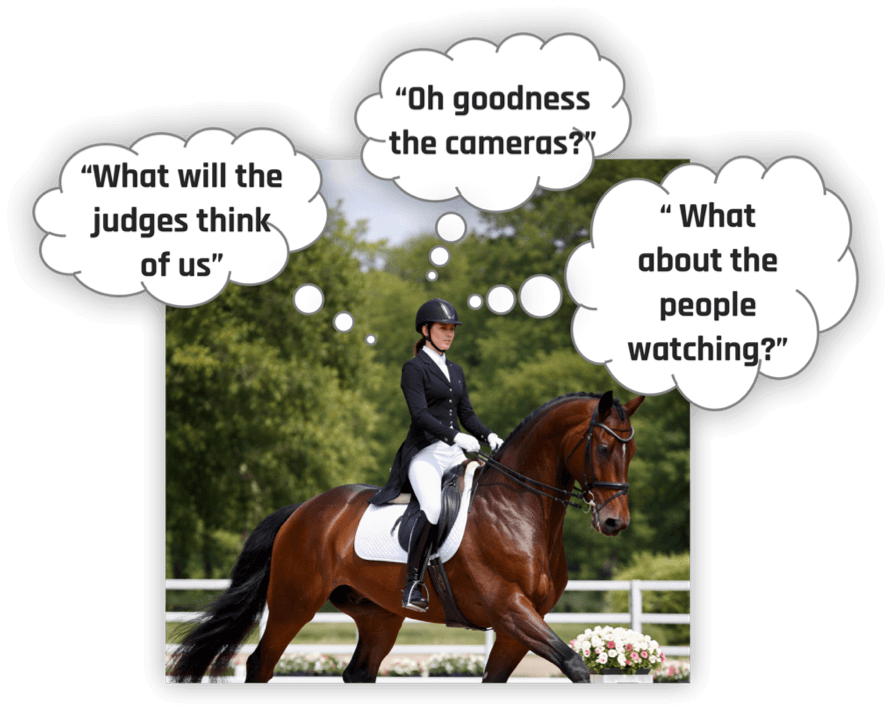
What your horse might do. What happened last time. Who is watching. What might happen next.
And when your attention is there, it is no longer fully available to you, your horse and what is actually happening.
This part is about learning to notice where your attention has gone and deliberately bring it back to the present moment and the next useful thing you need to do.
The goal: to ride what is actually happening, rather than what you are frightened might happen.
What’s crucial is how all four parts work together
You can calm yourself, but anxious thoughts can fire it all up again.
You can challenge a thought, but an overprotective nervous system can still sound the alarm.
You can feel calm at home, but lose confidence when your attention disappears into comparison or fear of judgement.
And one difficult experience can still knock you badly if you fundamentally do not trust yourself.
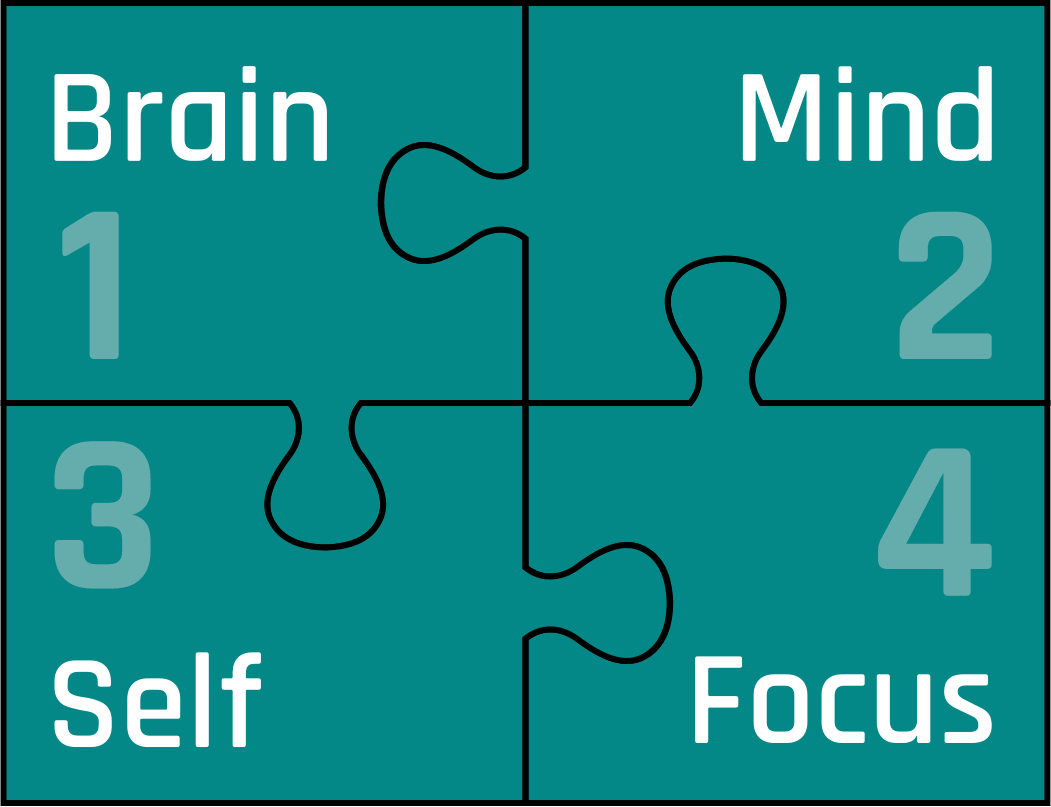
That’s why lasting rider confidence is not about finding the one technique that works.
It is about training the complete system.
Calm the survival brain.
Train the thinking mind.
Change your relationship with yourself.
Direct your focus and attention.
Together, these four parts create the foundations for rider confidence that is calmer, more resilient and far less dependent on having a good day because everything going perfectly.
“But my situation is completely different. How can the same approach work for me?”
Your situation is unique. The way your brain creates anxiety is not.
Your horse is unique. Your riding history is unique. And the experiences that have shaped your confidence are unique too.
You might be frightened to hack alone, struggling after a fall, anxious in a busy warm up, worried about cantering in an open space or simply wondering why riding no longer feels the way it used to.
Different circumstances, same underlying process.
The human brain uses the same fundamental systems to create anxiety whether you are nervous about walking down a quiet lane or competing at a high level.
That is why the four part framework can apply to riders facing very different challenges.
Here’s why your Rider Confidence Rescue call is so important
The framework stays the same, but the application becomes personal.
We will look at how these four parts are showing up for you, in your circumstances, with your horse, and identify what may need attention first.
Because confidence is not something you either have or you do not.
It is something you can learn how to build.
“So who am I to help you with this?”
I trained in this work because I’ve lived it
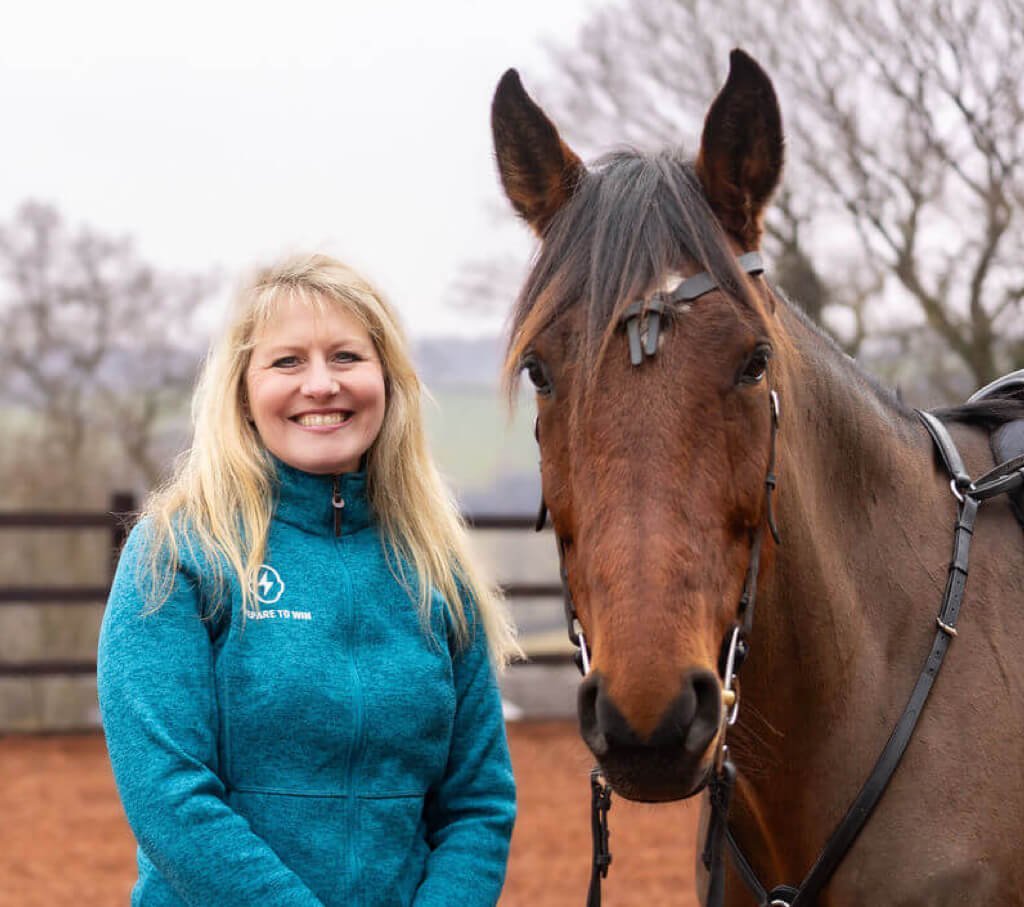
I’m a Mind Coach and Anxiety Specialist, and for the last 7 years I’ve helped hundreds of riders — from nervous beginners to elite professionals competing internationally — go from feeling anxious and afraid to feeling calm, connected, and genuinely confident in the saddle.
I’ve had the privilege of working with members of Team GB, and I’m proud to be the Mind Coach for the Royal Navy Equestrian Team.
But I didn’t arrive here from the outside looking in. I lived this.
“Years ago, I was going through a really difficult time in my personal life. Riding was my escape — my sanctuary — until I lost even that. The stress I was carrying started to affect my horse, and one day he bucked. It wasn’t even a bad buck, and I didn’t fall off. But in that moment, something shifted. Suddenly, I was afraid to ride.
It didn’t make sense. I loved my horse. I loved riding him. Nothing terrible had happened. But now I understand exactly what was happening in my brain — why it suddenly perceived riding as a threat, and why, instead of looking forward to it, I felt fear.
That experience set me on a path to finding tools that actually work. I overcame my own fears, rebuilt my confidence, and today I ride with complete trust and enjoyment again.”
Since qualifying as a Mind Coach, I’ve helped hundreds of other riders do the same. Which is why I know — if I can do it, and they can do it, you can too.
And I’d love to help you achieve that.
MORE THAN
7 YEARS
Helping riders overcome anxiety
MORE THAN
350+
Riders transformed
FOR RIDERS OF
ALL LEVELS
Beginners to Team GB professionals


“But does the same approach work for riders facing very different challenges?”
Real riders. Different challenges. Real results.
Rider confidence problems do not all look the same.
For one rider, it might be getting back on after a serious fall.
For another, it might be competing at a high level but quietly struggling with anxiety.
And for somebody else, success might simply mean being able to hack down the road and enjoy their horse again.
That is why I think it is important that you see what this work can look like for very different riders.
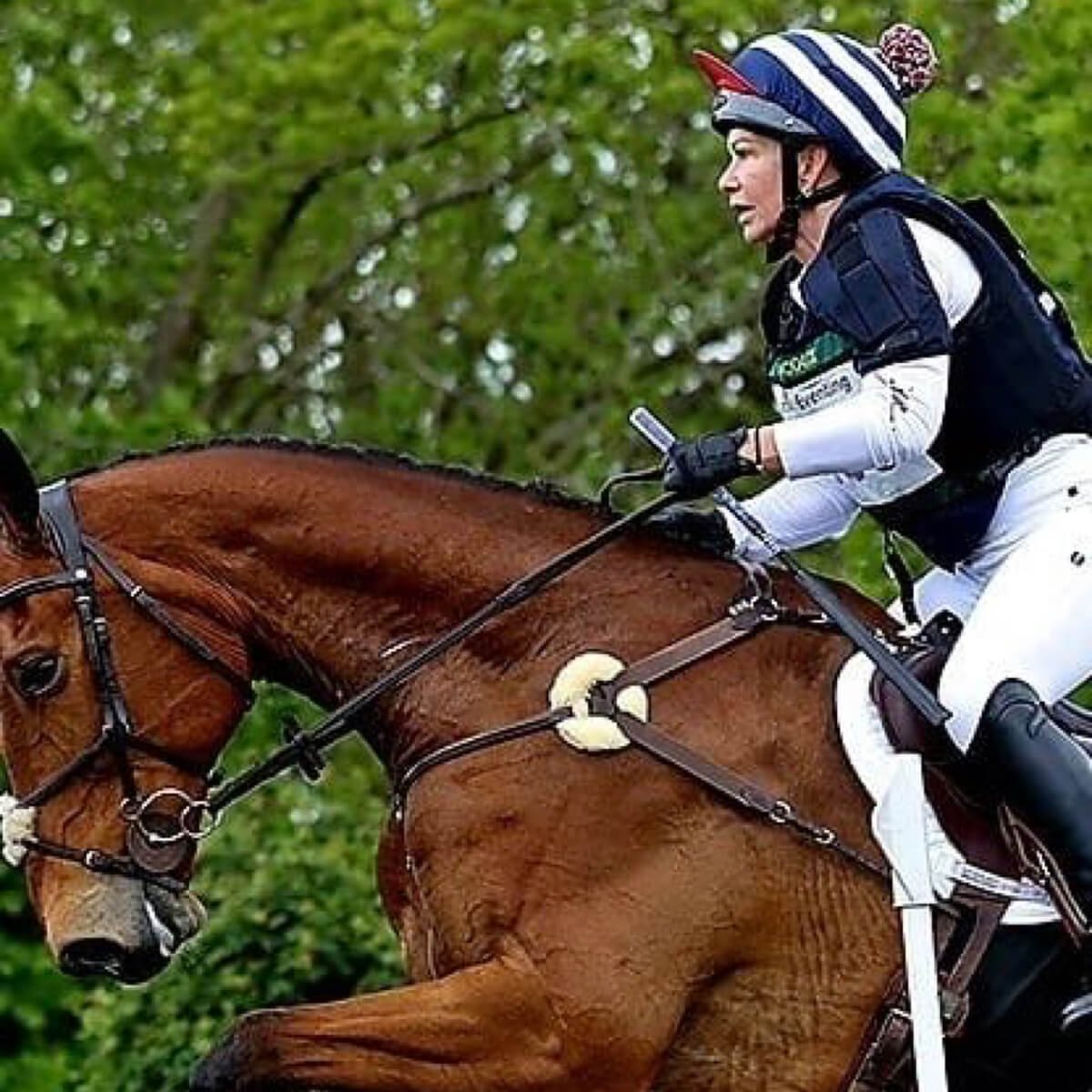
Heidi: Returning after a cross country fall
Event rider Heidi Maskelyne fell during a Cotswold Cup competition and broke her ribs.
She knew her body would heal.
But she was also aware that the experience could affect her psychologically the next time she went cross country.
So instead of waiting until she was back in the saddle to discover whether the fear was still there, Heidi used the time she was unable to ride to work on her confidence.
When she returned to cross country, she deliberately found the type of fence associated with her fall and rode it without the anxiety she had expected.
Her experience was later featured in Horse and Hound.
Heidi described going back into cross country feeling:
“calm, capable and confident.”
The important part of Heidi’s story is not that she is an event rider.
It is that she did not wait for confidence to magically return.
She trained it.
““I went specifically to find a trakehner on a downhill, as I wanted to replicate that jump. I wasn’t nervous at all — I’d done the work. I went in calm, capable, and confident, which is now my mantra.
I had a great afternoon and I was buzzing afterwards.
– Heidi Maskelyne
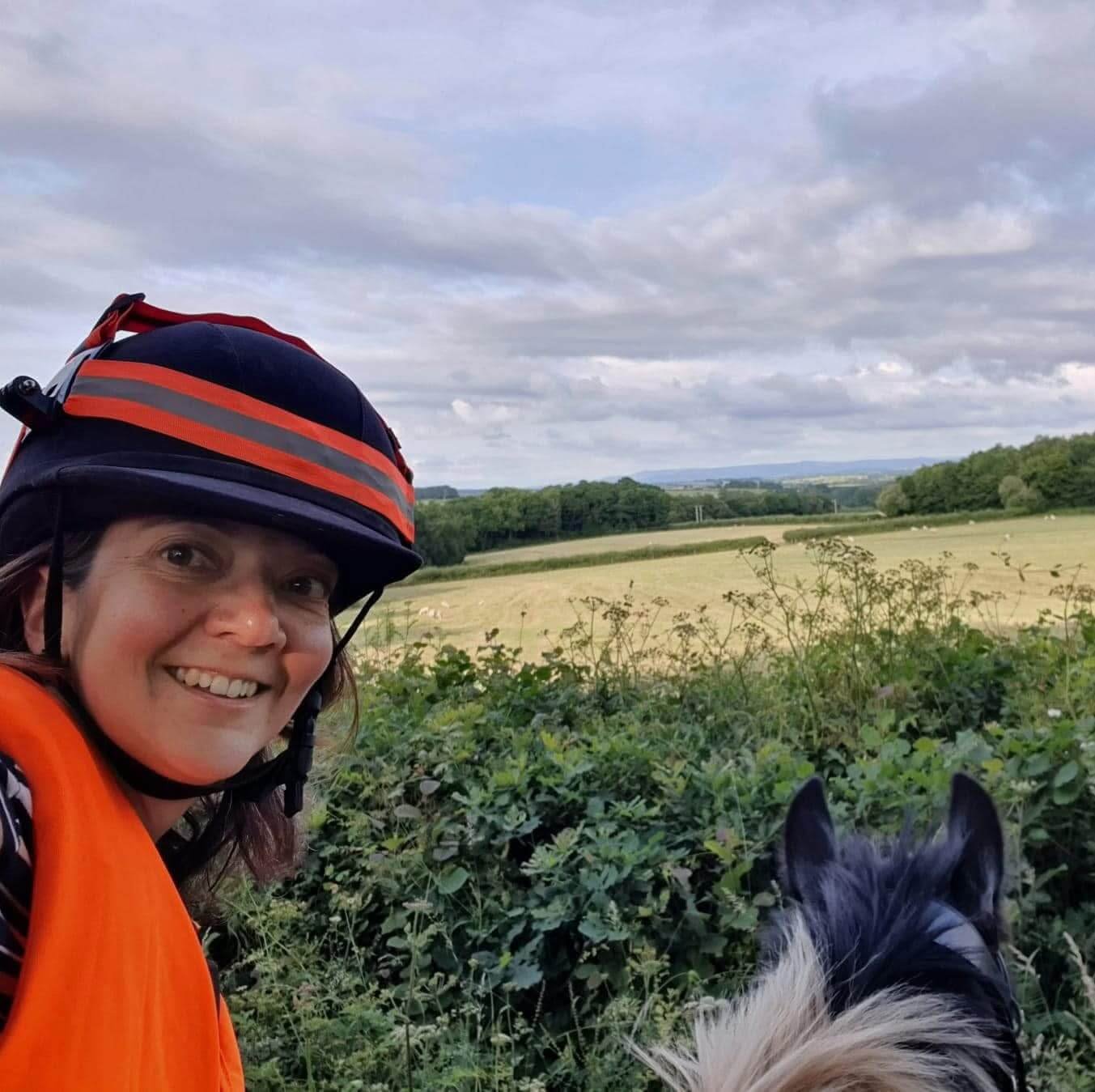
Cat: “A happy hacker who wasn’t happy to hack anymore”
Cat was not trying to win competitions or ride at an elite level.
She simply wanted her ordinary life with her horse back.
She described herself as:
“a happy hacker who wasn’t happy to hack anymore.”
Her confidence had become restrictive enough that even everyday things with her horse had become difficult.
As she worked on the underlying confidence patterns, her world began opening up again.
She progressed to clipping her horse herself, going on a fun ride and boxing to new places to hack.
For Cat, success was not measured by the height of a fence.
It was measured in freedom.
Being able to do the things with her horse that anxiety had gradually taken away.
“Sam’s really helped me with confidence on the ground and when riding – since I started with her, I’ve clipped my horse (by myself!), we’ve done a fun ride and boxed to new places with a friend to hack out.
Would recommend Sam to anyone who needs that friendly voice to get your confidence back and get going again.” ⭐️⭐⭐️️⭐️⭐
– Cat
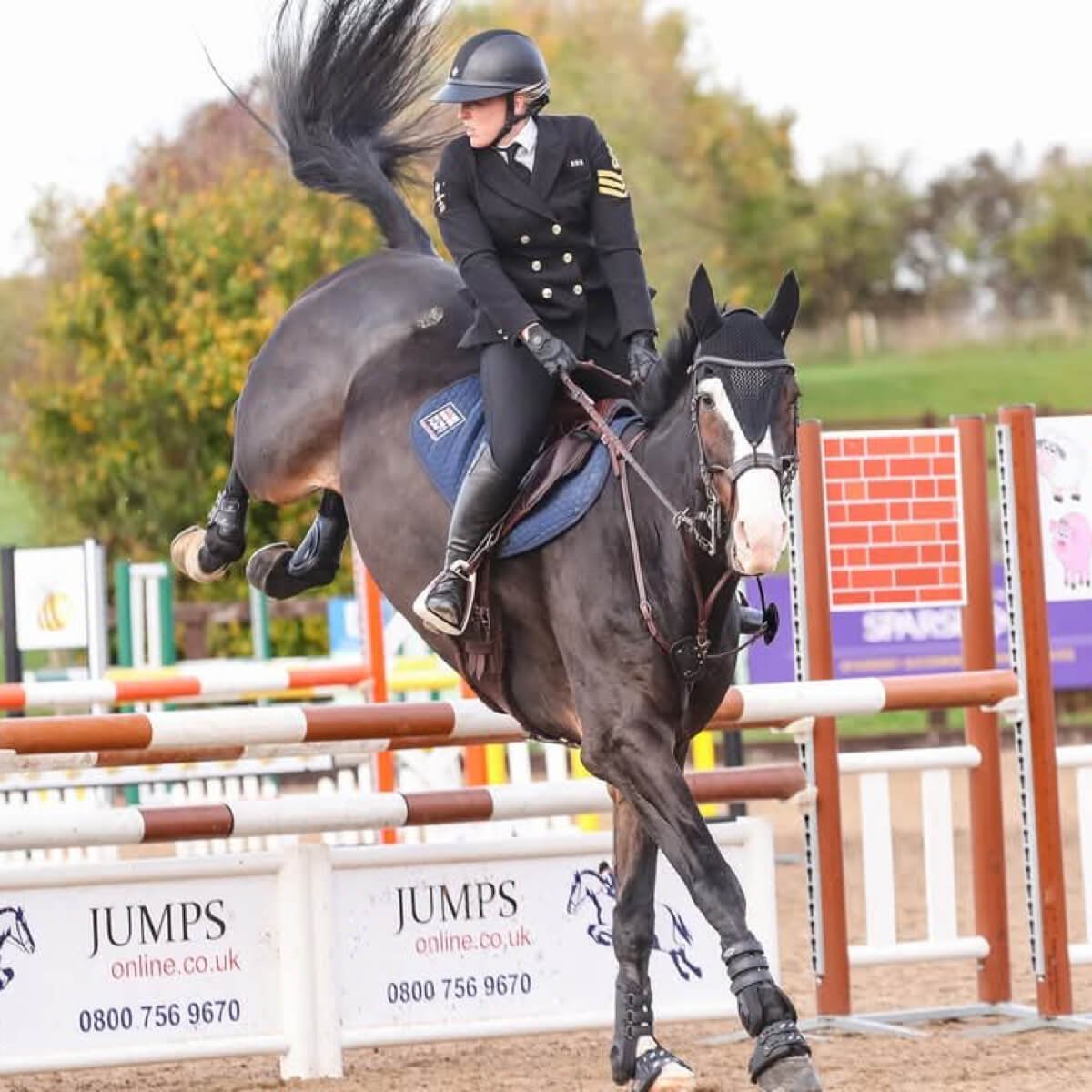
Amy: From overwhelmed in busy warm up rings to calm and focused
Amy struggled badly with anxiety in busy warm up rings.
Her attention was constantly being pulled towards the other horses, the other riders and everything that might go wrong.
Her horse, Bruno, was horse shy, which made Amy increasingly nervous. And the more stressful the warm up became, the more that anxiety followed them into their showjumping rounds.
Amy reached the point where she felt she could predict how her round would go simply by how stressed they had both become beforehand.
So rather than trying to control everything happening around her, we worked on training her attention.
Amy learned to bring her focus back to herself, Bruno and the job directly in front of them.
And something remarkable happened.
As Amy’s focus became calmer and steadier, Bruno stopped being horse shy.
Nothing about the busy warm up suddenly became more predictable.
What changed was where Amy’s mind went when she was in it.
And that changed the experience for both her and Bruno.
“I learned to worry less about what others were doing and focus solely on us and the warm up isn’t an issue anymore.
It’s honestly magic.”
– Amy Taylor
“So how do I actually work through all four parts?”
Introducing
The Confident Rider Course
Understanding why your confidence has changed can be a huge relief.
But understanding alone does not change the way your brain responds.
To create lasting confidence, you need to actually train the four parts of the system you have just been reading about.
That is exactly what the Confident Rider Course is designed to help you do.
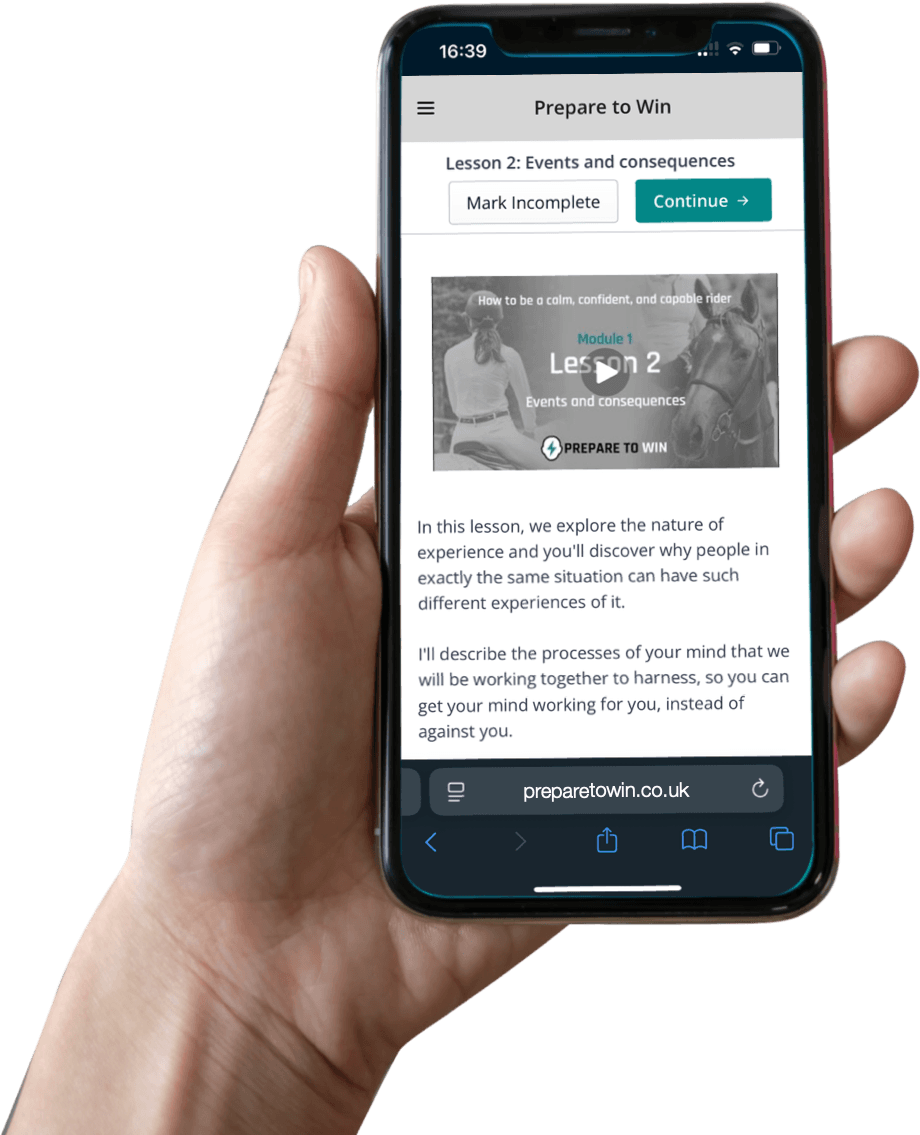
This is my complete rider confidence programme
The Confident Rider Course is not a shortened or basic version of my work.
It is the complete, structured programme I have developed through years of working with hundreds of riders experiencing anxiety, nerves, fear and loss of confidence.
You work step-by-step through all four parts in a deliberate order:
Calm your survival brain and nervous system
So your body becomes less likely to treat manageable situations like emergencies.
Train your thinking mind
So frightening predictions and “what if” thoughts have far less power over how you feel and ride.
Change your relationship with yourself
So mistakes, setbacks and difficult days do not cause your confidence to collapse.
Train your focus, awareness and attention
So you can stay present with your horse and respond to what is actually happening.
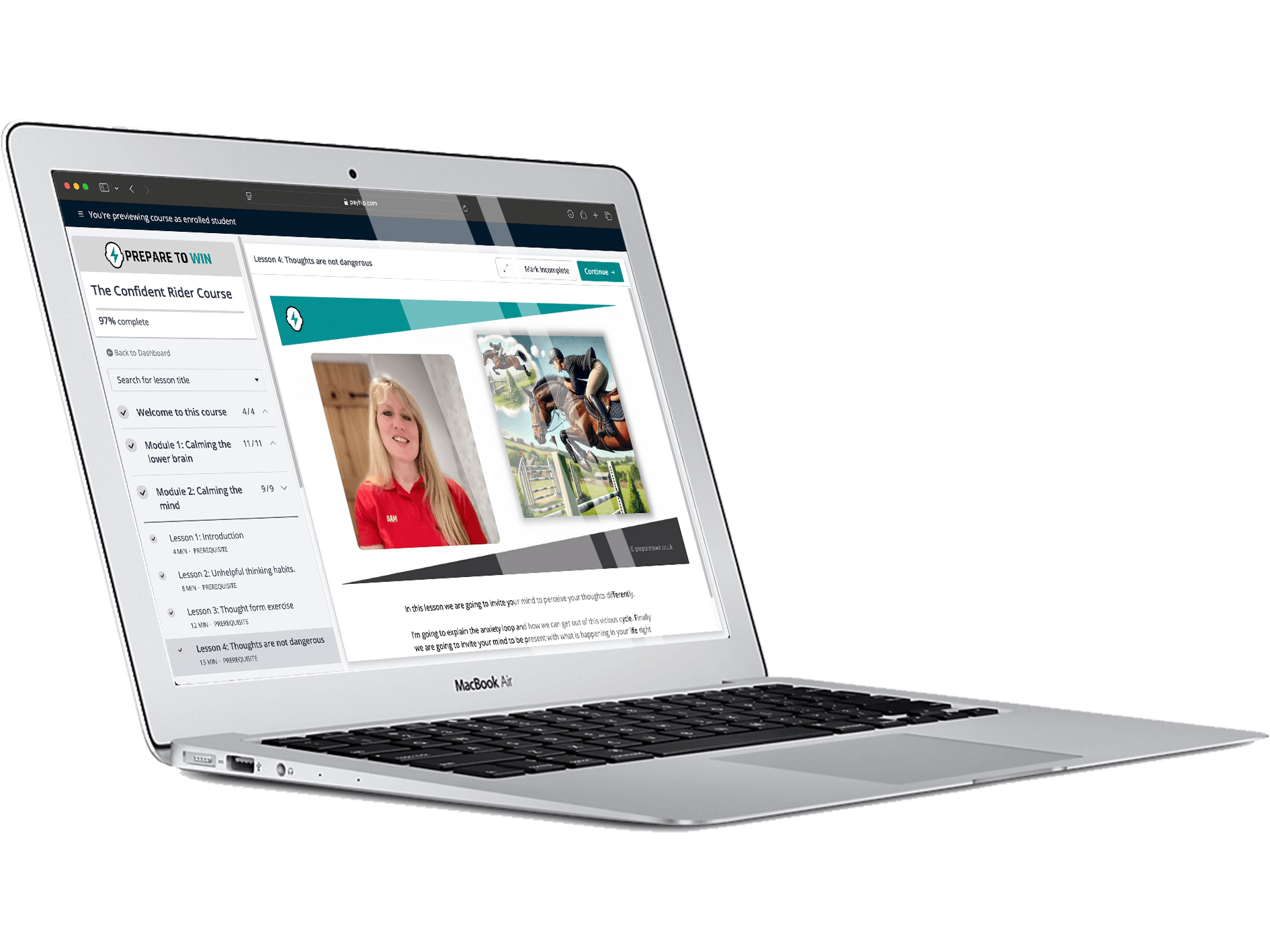
Rather than giving you another collection of tips to remember when you are already anxious, the programme helps you work systematically on the patterns underneath your confidence.
You learn what to do, why it works, how to apply it and how to practise it, so those skills become increasingly available when you actually need them.
Because lasting confidence has to be trained
You would never expect to improve your riding simply by understanding the theory.
You practise.
You repeat.
You develop skills until things that once required enormous conscious effort begin to feel more natural.
Psychological confidence works in much the same way.
The aim is not for you to constantly fight anxiety with techniques.
It is to help your brain and body learn different ways of responding, so calm, clear thinking and self trust become increasingly familiar.
That is why the Confident Rider Course is structured as a process rather than simply being a library of information.
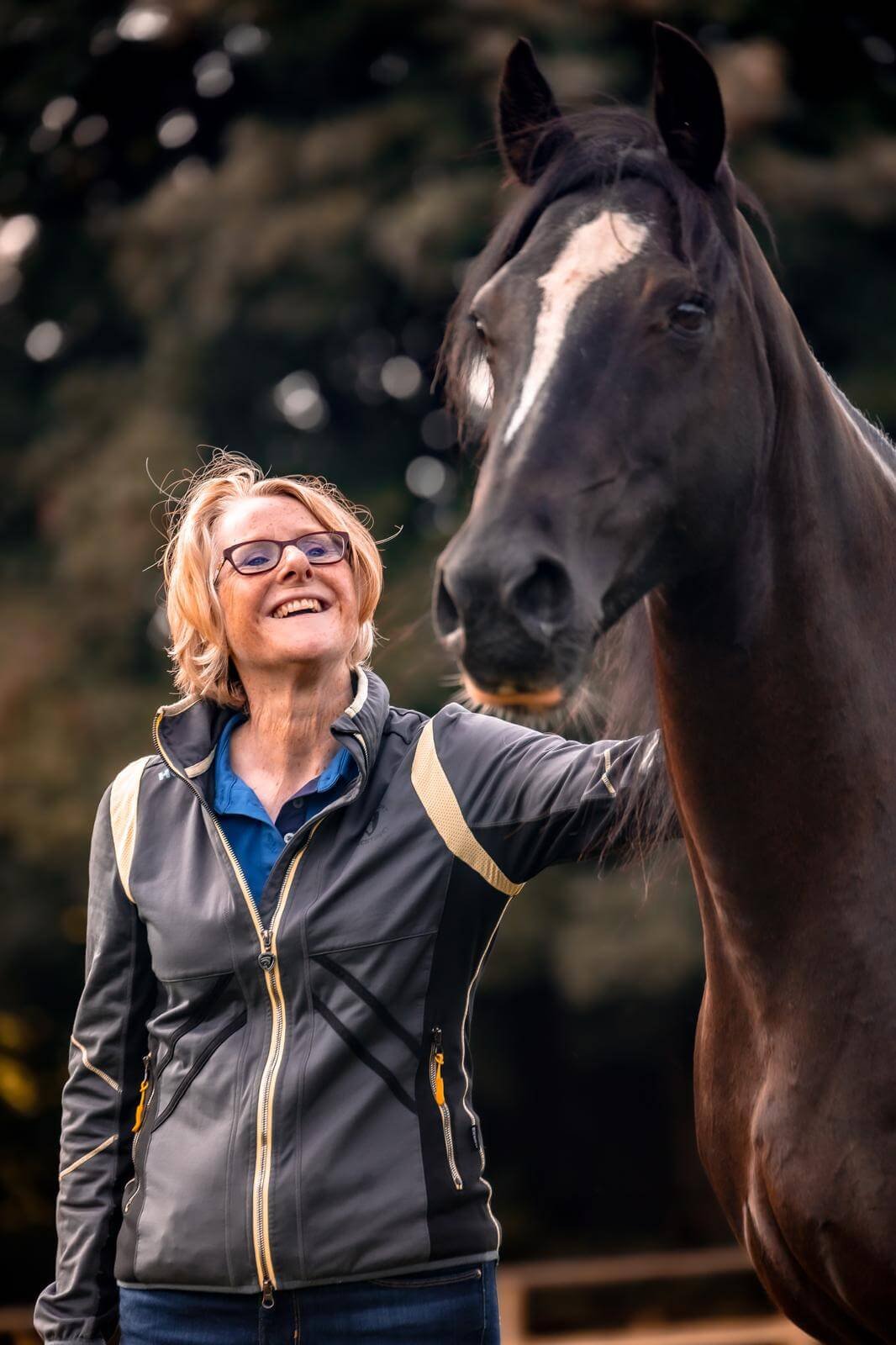
Michelle, one of my wonderful clients.
And you work through it at your own pace
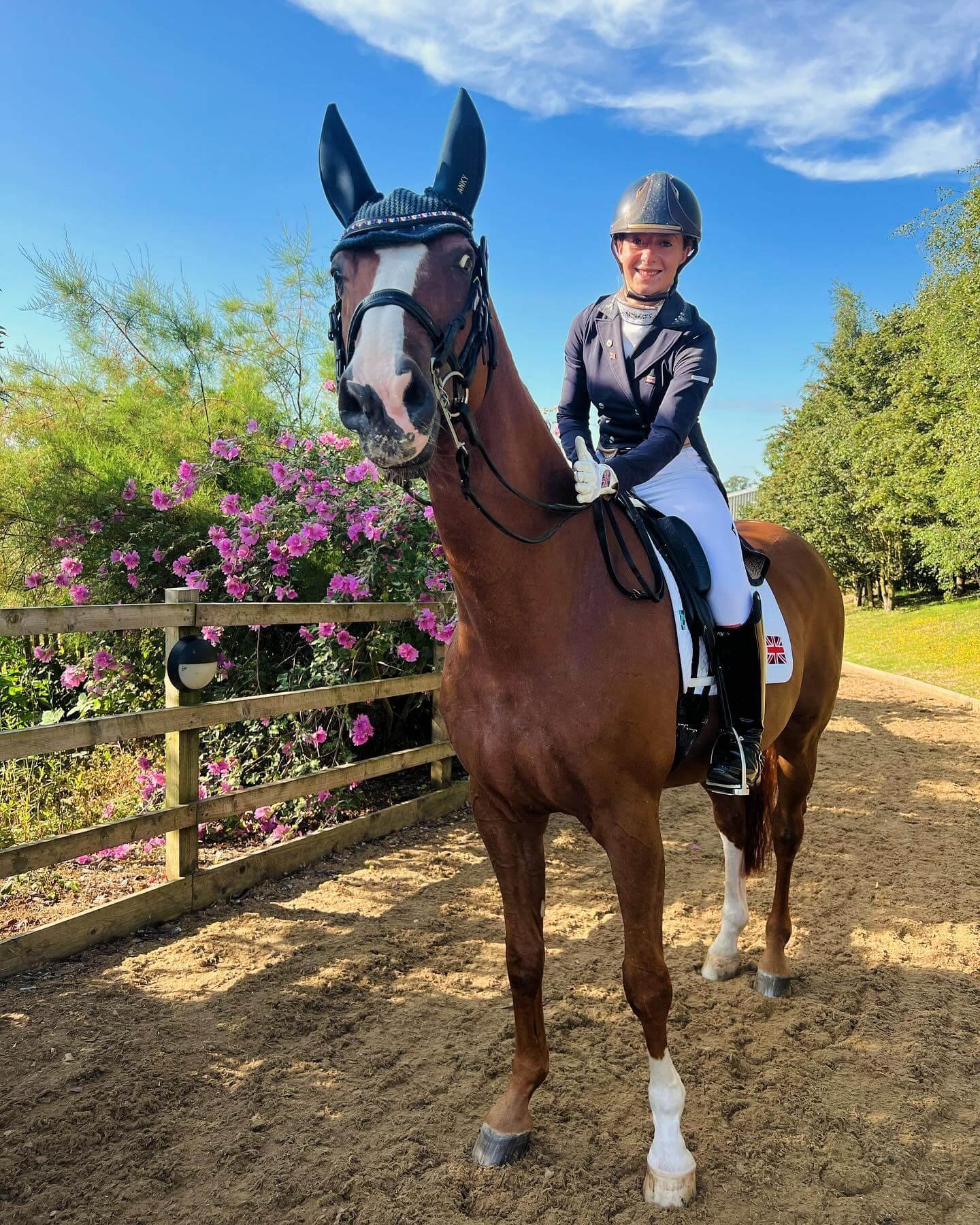
Victoria, Team GB rider and fabulous client!
You do not need to complete everything at once.
You do not need hours every day.
And you certainly do not need to become a perfect student.
You work through the programme in a deliberate order, at a pace that fits around your life and your horses.
And because you have lifetime access, you can return to the material whenever your riding, horse, circumstances or goals change.
The objective is not simply to help you feel better for a few days.
It is to give you psychological skills you can continue using…
For the rest of your riding life
“What would I actually work on inside the course?”
Here’s how you’ll put it all into practice
The Confident Rider Course is not about watching videos and hoping you feel more confident afterwards.
You work through a structured process that helps you apply the four part framework to your own riding, your own triggers and your own confidence patterns.
Inside the Course, you will learn how to:
Recognise what is happening when anxiety starts to build
Calm and regulate your nervous system before fear takes over
Work differently with anxious thoughts and “what ifs”
Challenge the self talk and beliefs that undermine your confidence
Bring your attention back to your horse, the present moment and what actually needs to happen next
Practise those skills repeatedly so they become easier to access when you need them
You are not expected to change everything at once.
You work through the programme in a deliberate order, building one skill on the next and applying what you learn to the situations that matter to you.
The aim is not simply to understand confidence better.
It is to become increasingly able to think, feel and respond differently when you are actually with your horse.
“So now I understand what’s happening, shouldn’t that be enough to change it?”
Information is not transformation
Understanding your anxiety matters.
It can make what you are experiencing feel less mysterious and help you understand why your brain and body have been responding the way they have.
But understanding a response is not the same as changing it
Your brain learns through experience, practice and repetition.
That is why the Confident Rider Course is not simply information to watch and remember.
You learn the skills, practise them, apply them to your own riding and repeat them until calmer, clearer responses become increasingly familiar and easier to access when you actually need them.
Because there is a big difference between knowing what to do and being able to do it when the pressure rises.
The goal is not for you to become better informed about rider confidence.
The goal is for you to become a calmer and more confident rider
That requires more than information. It requires practice that creates change.
“So what do I actually get to help me put all of this into practice?”
Everything you need, forever.
The Confident Rider Course gives you a complete, structured way to work through all four parts of genuine rider confidence.
You are not left with a collection of ideas and expected to work out what to do next.
You have the training, exercises, practical tools and support to help you apply the process to your own riding, at your own pace.
The complete Confident Rider Course
Over five hours of structured, on demand video training
Taking you step by step through the complete rider confidence framework.
Each part builds on the one before it, so you are not jumping randomly between techniques or trying to change everything at once.
You will learn how to:
- Calm and regulate your nervous system
- Work differently with anxious thoughts and “what ifs”
- Strengthen your relationship with yourself
- Train your focus, awareness and attention
- Apply those skills to the situations that matter to you and your horse
And because the lessons are on demand, you can work through them when it suits you rather than having to fit your life around scheduled training.
Seven guided visualisation and audio exercises
Knowing how to do something is useful.
Sometimes, though, it is much easier to simply press play and be guided through it.
You receive seven guided visualisation and audio exercises designed to support the work you are doing inside the Course.
You can use them before riding, around situations that normally trigger anxiety, or simply as part of your regular mental training.
They give you a practical way to reinforce the calmer, clearer responses you are developing.

Lifetime access
There is no deadline hanging over you.
You can work through the Course at your own pace and return to it whenever you need it.
That matters because your riding will change.
Your horse may change.
Your goals may change.
And different parts of the Course may become relevant again at different stages of your riding life.
So rather than completing the programme once and losing access, you keep it for life.

Support from me when you need it
You are not expected to sit there wondering whether you have understood something correctly or how it applies to your particular situation.
If you have a question while working through the Course, you can contact me for guidance.
Sometimes a little clarification is all you need to keep moving forward.
And knowing that support is available can make it much easier to engage with the process rather than getting stuck and giving up.

A private community of riders working on the same things
Confidence struggles can feel surprisingly isolating.
It is easy to look around the yard and assume everybody else is coping perfectly.
Inside the private members community, you can connect with riders who understand what this process feels like because they are working through it too.
It gives you somewhere supportive to ask questions, share progress and see what other riders are learning along the way.
Keep using everything long after you finish the course
The real value of the programme is not simply what you have access to.
It is what you learn to do.
How to calm yourself when your nervous system becomes activated.
How to respond when your mind predicts disaster.
How to recover after a difficult ride.
How to direct your attention when pressure rises.
How to become steadier, clearer and more available to your horse.
Those are not skills you use once.
They are skills you can continue drawing on every time you ride.
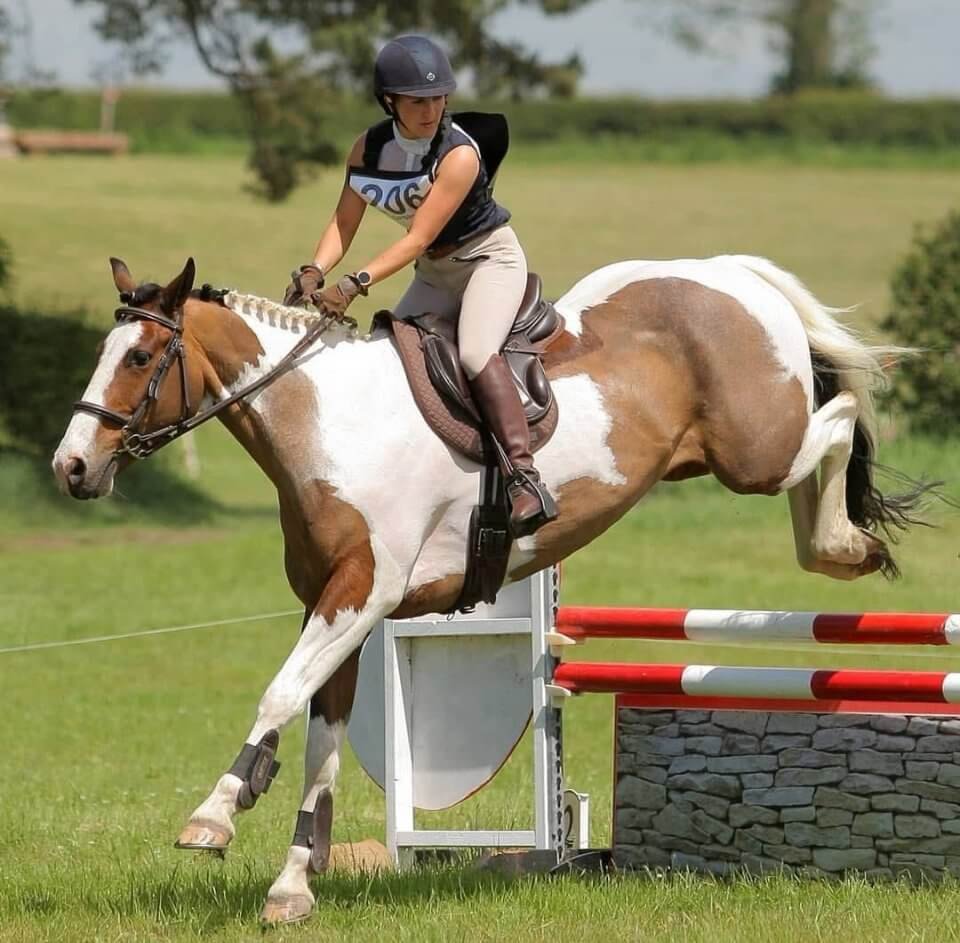
Caroline, one of my wonderful clients.
“What am I really investing in here?”
You’re not investing in training. You’re investing in what becomes possible.
If you think of the Confident Rider Course as a few hours of online training, you will completely misunderstand what it is designed to give you.
You are not simply learning more about anxiety.
You are developing skills.
Skills that can change the way you think, feel and respond every time you are with your horse.
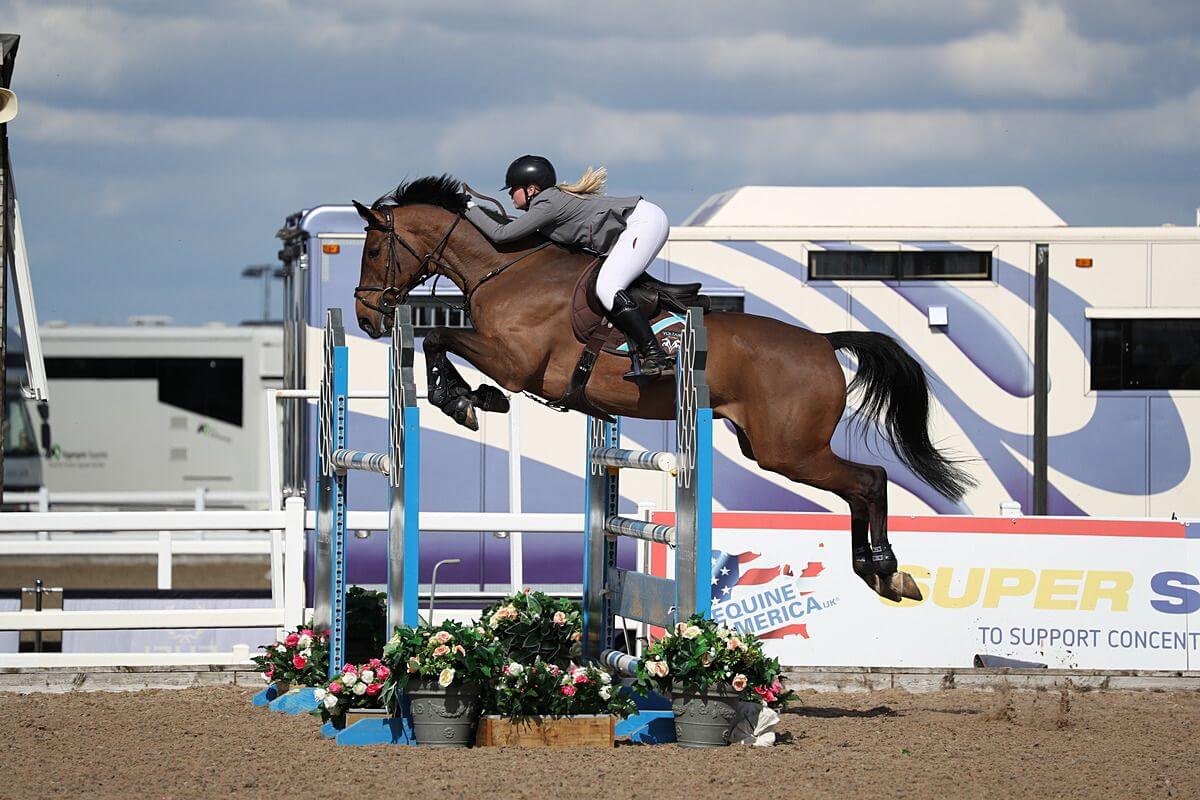
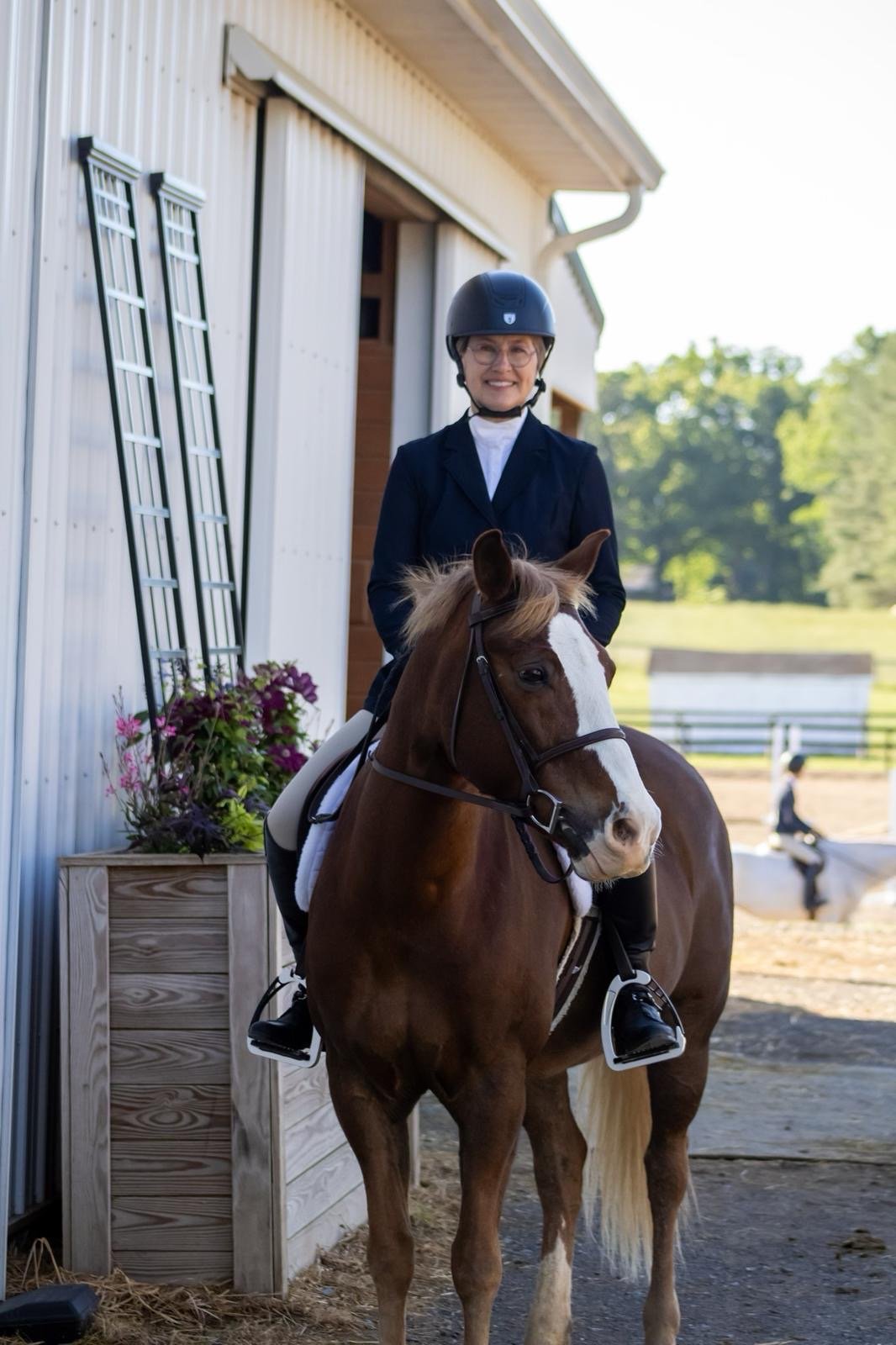
(And yes, every rider pictured here is one of my wonderful clients!)

The ability to calm your nervous system
So when your body begins preparing for danger, you know how to help it settle rather than simply being swept along by the response.
The ability to think clearly when anxiety starts predicting disaster
So a frightening thought does not automatically become something you treat as fact.

The ability to trust yourself to make sensible decisions
So confidence is not dependent on everything going perfectly.
You can assess what is happening, respond appropriately and know that you can handle the situation in front of you.
The ability to recover when something goes wrong
Because horses are horses. There may be difficult rides. Unexpected moments. Mistakes. Spooks. Setbacks.
Confidence is not about pretending those things will never happen. It is about being able to experience them without allowing one moment to determine how you feel for the next six months. Or longer…

The ability to stop your inner voice making everything harder
So a mistake does not become: “I’m useless.”
A difficult ride does not become: “I can’t do this.”
And somebody else’s opinion does not determine what you believe about yourself.
The ability to keep your attention where it actually helps you
So instead of focusing on what might go wrong, what your horse might do or what other people might think, you can bring your attention back to the ride you are actually having and what you need to do in that moment.
All these skills come with you every time you ride
They are there when you hack. When you have a lesson. When you compete. When you ride somewhere new. When something unexpected happens.
Because you are not simply learning more about confidence. You are developing skills you can use again and again:
To calm yourself, think clearly, recover from setbacks, trust your decisions and keep your attention where it helps you most.
Those skills become part of how you ride.
…and that changes the way I invite you to think about the course
Most riders spend a considerable amount of money looking after the horse side of the partnership.
Livery… Feed… Lessons… Saddles… Physio… Veterinary care… Dentistry… Transport… Competition entries… Equipment… Training.
We invest in those things because our horses matter to us. But there is another equally important part of the partnership that comes with you every single time you are with your horse.
You. Your nervous system. Your thoughts. Your attention. Your decisions. Your ability to remain calm and communicate clearly.
You can have a horse you adore, a saddle that fits beautifully, a great instructor and all the equipment you need.
But if part of your brain is still anticipating danger, doubting your ability or constantly imagining what might go wrong, it can still be incredibly difficult to relax, enjoy your horse and make full use of everything else you have put in place.
This is where investing in yourself can make such a difference.
Because when you develop your part of the partnership, it can change the way you experience everything else, too.
So the real question is not “How much content is in the Course?”

Jill, one of my wonderful clients.
The real question is: What would change if you could use these skills every time you needed them?
What would riding feel like if you could get on without that knot in your stomach
Hack without mentally searching for the next disaster?
Have a lesson and concentrate on learning rather than worrying about being judged?
Canter without spending the previous week thinking about everything that could go wrong?
Compete and actually enjoy being there?
Trust yourself when something unexpected happens?
Or simply wake up knowing you are going to the yard and feel excited again?
That is what you are really working towards. Not more information. More freedom with your horse.
“What would solving this actually give me back?”
What is rider confidence worth when fear is deciding what you can and cannot do?
When anxiety starts shaping your riding, the cost is not only the things you stop doing.
It is the time spent worrying before you ride. The energy spent managing your nerves while you are riding. And finishing something you once loved thinking “Thank goodness that’s over.”
Little by little, fear can start making decisions that should belong to you.
What if riding could feel different again?
Imagine getting on without spending the previous hour trying to talk yourself into it.
Imagine hacking where you want to hack without constantly scanning for everything that might go wrong.
Imagine hearing the word “canter” and simply thinking about riding the canter.
Imagine arriving at a competition excited to ride rather than wishing you could disappear.
Imagine if a difficult moment with your horse meant trusting yourself to deal with what is actually happening instead of immediately assuming the worst.
Imagine taking a correction in a lesson and thinking “That’s useful. Let me try again.” rather than “Everyone can see I’m not good enough.”
Imagine coming home from the yard thinking: “I really enjoyed that.” instead of: “Thank goodness that’s over.”
Confidence gives you more than the ability to do bigger things
For some riders, confidence means jumping again, competing again or hacking alone.
For others, the biggest change is simply enjoying the horse they already have.
Either way, it means having more freedom to make riding decisions based on what you want, rather than what anxiety will allow.
And there is one thing none of us can buy back…
Time with our horses.
Confidence rarely arrives simply because you waited long enough.
It grows when you start training the things that create it.
So before we speak, I would invite you to think about one question:
How much more time with your horse are you willing to lose waiting for this to change by itself?
You don’t need to know the answer yet.
But it is worth thinking about before we speak.
“If I decide I want more of your help, what are my options?”
Three ways to work with me
The same complete approach. Different levels of personal support
There are three ways I can help you take what you have been reading about and put it into practice. The underlying rider confidence principles remain the same.
What changes is how much individual support you would like from me along the way.
The Confident Rider Course
My complete structured rider confidence programme.
You work through the full process at your own pace, with the training, tools and resources you need to apply it to your own riding, plus support from me when you need guidance.
This is ideal if you are comfortable working relatively independently and want a clear process you can return to whenever you need it.
For many riders, the Course is all the support they need.
The Hybrid Programme
The complete Course, with additional individual coaching and support.
You follow the same structured programme, but with dedicated opportunities for us to look together at how it applies to you, your horse and the situations where you are getting stuck.
This can suit riders who value independence but would like more personal guidance along the way.
Private one to one coaching
The highest level of personalised support
The Confident Rider Course still provides the underlying framework, but we have considerably more opportunity to work closely together around your particular history, confidence patterns, horse, challenges and goals.
This is generally best suited to riders who want regular individual coaching, greater personal input and a more closely supported process.
“How do I know which level of support I actually need?”
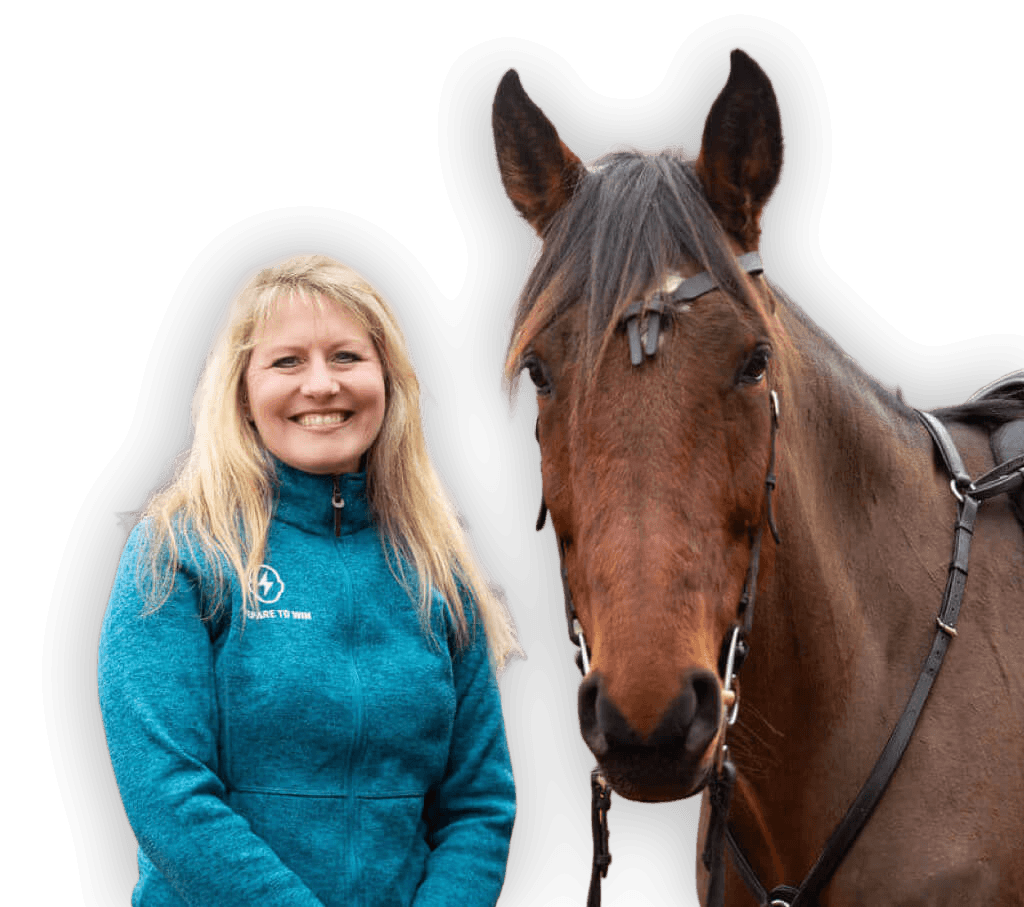
That’s one of the things we will work out together on your call
You do not need to diagnose yourself before we speak. And you do not need to decide which programme, if any, is right for you. That is part of the purpose of your Rider Confidence Rescue Call.
We will talk through:
What has been happening with your confidence
Where the anxiety or nerves tend to show up
What seems to trigger them
What you have already tried
What you would like your riding to feel like instead...
...and how much personal support would realistically help you move forward
From there, I can give you an honest recommendation.
That may be one of my paid rider confidence programmes.
Or I may tell you that I do not think you need to work with me at all.
The aim is to help you choose the right level of support for you
If I believe I can help, I will explain what I recommend, why I think it is the best fit, what support is included and what the investment would be.
There is no obligation to join anything.
You simply leave the call knowing what I believe would give you the best chance of creating the change you want.
“What if I start the course and don’t feel any difference?”
The “Feel the Shift” guarantee
If you have tried other things before without getting the change you hoped for, it is perfectly reasonable to wonder whether this will be different.
That is why the Confident Rider Course is protected by my Feel the Shift Guarantee.
Complete Module 1 and do the accompanying exercises
If you do not experience the tangible early shift in your mindset and confidence covered by the guarantee, let me know within the guarantee period and you can request a full refund in accordance with the guarantee terms.
So you do not simply have to take my word for it. You have the opportunity to experience the first part of the process for yourself.
Common Questions
What age group is the course suitable for?
Riders from age 13 right up to 80 have successfully completed the course — and we have a rider who started at 80. Anxiety doesn’t have an age limit, and neither do the tools. If you ride and you want to feel calmer and more confident in the saddle, this course is for you.
Is this course suitable for novices?
Absolutely. The course has helped complete beginners ride with calmness and confidence, and it has also helped experienced competitors — including riders jumping 1.50m internationally. The tools work at every level, because they work with the brain, not with riding technique.
I want to do the course, but I don't feel mentally ready.
That feeling is completely understandable — and it’s actually your anxious mind doing exactly what it’s designed to do. The anxious brain perceives anything new as a potential threat, even things that are going to be good for you. It’s trying to keep you safe, but it’s keeping you stuck. The good news is that you don’t need to feel ready to start. You just need to take the first step. The course is designed to support you through the changes, even if you’re nervous or unsure.
I'm worried it won't work for me.
This is one of the most common concerns I hear — and it makes complete sense, especially if you’ve tried things before that haven’t helped. The course is grounded in neuroscience. As long as you go through the lessons and follow the steps, you will begin to notice real changes. The course works by retraining how your brain processes information and settles your nervous system — which is why the results tend to be lasting rather than temporary.
I'm a complete beginner — is this right for me?
Yes. The course works with how your brain responds to fear and stress — and that’s universal, regardless of your level. You don’t need to fit a particular mould. You just need a process that works.
I'm an experienced rider. Will this still help me?
Yes. Many of the riders I’ve worked with are experienced competitors — including professionals. Anxiety doesn’t discriminate by ability. If anything, experienced riders often feel more pressure to ‘just get on with it,’ which makes the inner work even more important.
How long will it take to see results?
Many riders begin noticing real shifts after the very first module, though results will vary from person to person. The course is self-paced and delivered in short, manageable lessons — designed to fit into real life, not compete with it.
I'm not riding at the moment due to injury. Can I still benefit?
Yes — and in fact, this is an ideal time to do the work. You don’t need to be in the saddle to begin retraining your brain. When you come back to riding, your mind will be in a much better place.
What if I've tried other courses or coaches before?
If previous approaches haven’t worked, it’s almost certainly because they addressed only one part of the system. The Confident Rider Course works with all four strands of anxiety simultaneously — that’s what makes it different, and why it works when other things haven’t.
How does the money-back guarantee work?
It’s straightforward. Complete Module 1 and do the exercises. If you don’t feel you’ve gained anything of real value, simply email me and I’ll refund you in full — no questions asked. You have nothing to lose by trying.
How is this different from one-to-one coaching?
The course gives you the same system I use with all my clients, structured, step by step and self paced. You also get unlimited email support directly from me, so you’re never on your own. The difference is that you work through the programme independently, using the tools and techniques in your own time, while one to one coaching gives you a greater level of personalised support along the way
“Before we speak, there are three things I’d like you to think about.”
Come to your call with these three questions in mind
You do not need to write anything down or have all the answers.
Just spend a few minutes thinking about these three things before we speak.
1. What is your lack of confidence costing you right now?
And I do not just mean financially.
What are you no longer doing? What are you enjoying less? What decisions are you making because of fear rather than because they are what you genuinely want?
Perhaps your riding world has become smaller. Or perhaps you are still doing many of the same things, but riding now feels like something to get through rather than something to enjoy.
Think about what allowing things to stay as they are is really costing you.
2. What would you genuinely love instead?
For a moment, forget about whether you think you can achieve it.
Ask yourself: “What do I actually want my riding and my relationship with my horse to feel like?”
Maybe it is hacking alone again. Cantering without dread. Enjoying lessons. Competing without feeling sick. Trusting yourself when something unexpected happens. Or simply enjoying being with your horse the way you used to.
It does not need to sound impressive. It only needs to matter to you.
3. How ready are you for things to be different?
Think about how your confidence is affecting you now and what you would like to be able to do, feel or enjoy differently.
Ask yourself: “How important is it to me to make a change?”
You do not need to know how to get there yet. That is part of what we can explore together.
But it can be useful to think about whether this is something you are genuinely ready to start addressing
That’s everything you need before we speak.
You’re ready for your Rider Confidence Rescue Call
Thank you for taking the time to read this page.
You now understand much more about why rider confidence can change, what may be keeping it stuck and how I work with riders to help change it.
But when we speak, the most important thing will be you. Your horse. Your experiences. What has been happening. What you are finding difficult. And what you would really love riding to feel like instead.
You don’t need to prepare anything else
You do not need to diagnose yourself. You do not need to know which programme, if any, is right for you. And you certainly do not need to arrive feeling confident or completely ready.
Just come prepared to talk openly about where you are now and where you would like to get to.
We can work out the rest together.
Before your call, just make sure you…
☑️ Have the appointment in your diary
☑️ Choose somewhere you can speak comfortably and without too many distractions
☑️ Allow yourself the full 60 mins we have booked together
☑️ Give a little thought to the three questions above
I’m looking forward to meeting you

Whatever your confidence looks like right now, you do not need to have all the answers or know exactly what needs to change.
Come to the call exactly as you are and talk me through what has been happening, what feels difficult and what you would love to be different.
Together, we can start making sense of what is getting in the way and look at what could help you move forward.
I’m really looking forward to speaking with you and helping you take that first step towards feeling calmer, more confident and more like yourself again with your horse.
I’ll see you on your Rider Confidence Rescue Call.
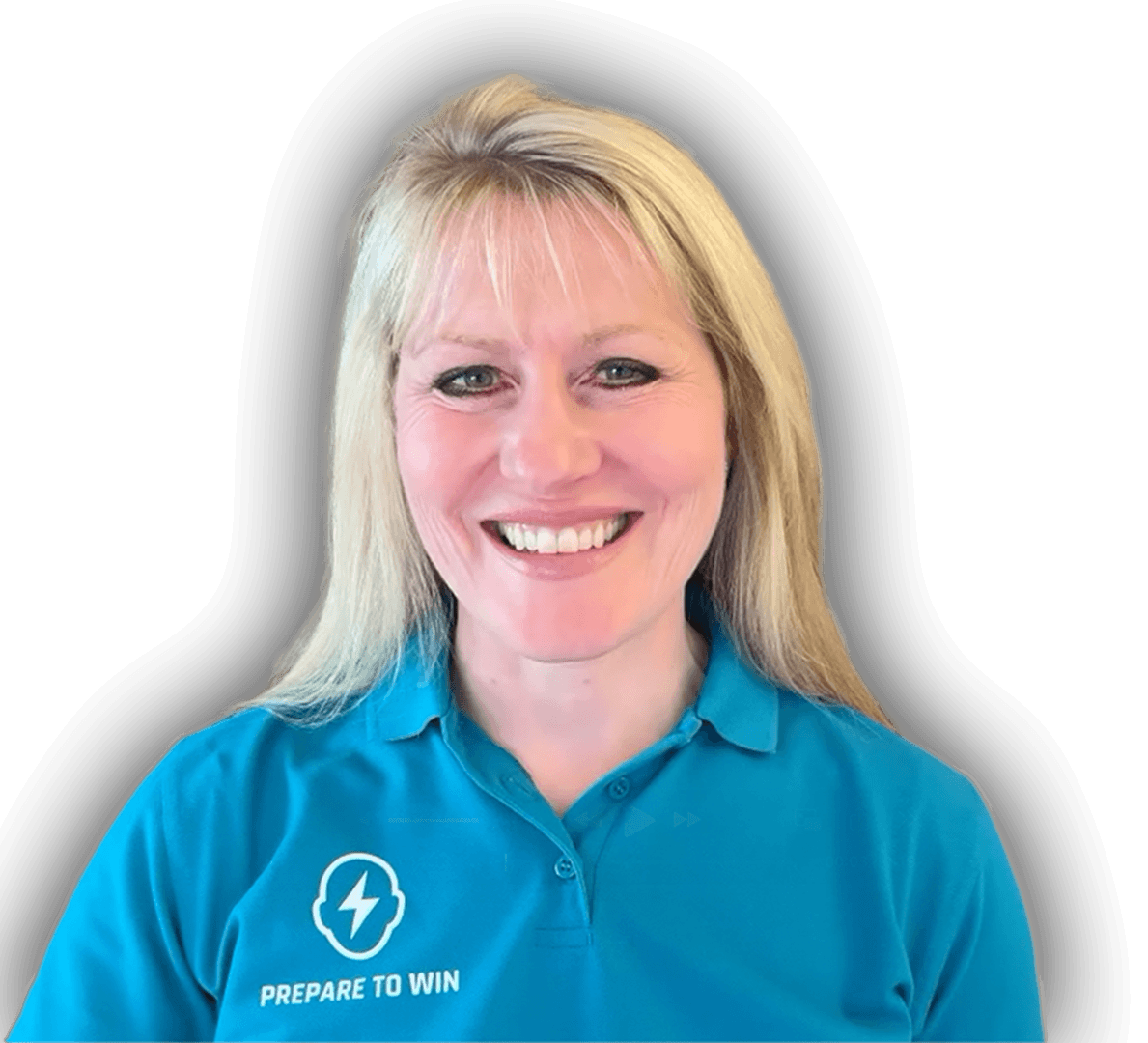
Sam